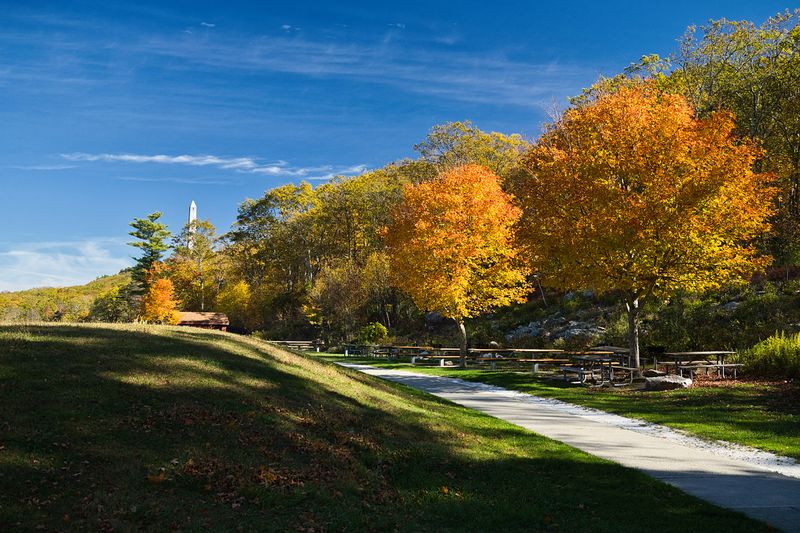
A 220-foot granite obelisk stands on the very top of a mountain, and you can climb 291 steps inside it. At the top, three states spread out below you at the same time.
One direction shows Pennsylvania and the Pocono ridges. Another shows the Catskills in New York.
The third is New Jersey, rolling south in green and gold.
I love that this tower was built to honor veterans from every war. That gives the climb a quiet purpose beyond the view.
The stone even came partly from quartzite quarried right on the property.
Around it sits a huge park with a spring-fed lake, bog trails, and the Appalachian Trail. I can’t imagine a better answer to anyone who thinks New Jersey is all highways.
So how many states can you spot before your legs stop shaking?
The Rooftop Of The Garden State Waits In Sussex County
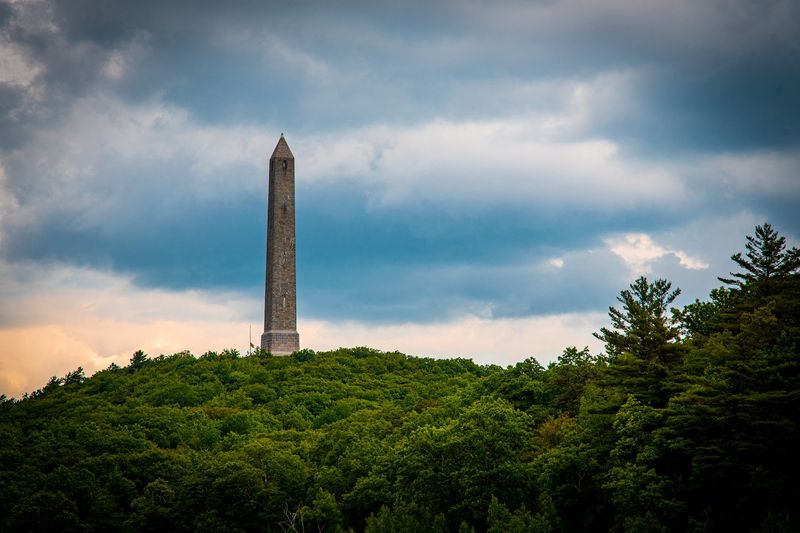
Head about as far north as New Jersey goes, and the ground keeps rising. High Point State Park and New Jersey Veterans’ Memorial crowns the Kittatinny Ridge in Sussex County.
The summit sits at 1,803 feet above sea level. That’s the highest elevation anywhere in the state, and it’s not a close contest.
The park spreads across Wantage and Montague townships. It covers more than 15,000 acres of forest, lakes, ridges, and wetlands.
The star of the show is the High Point Monument. This granite-clad obelisk rises 220 feet from the summit itself.
So you’re climbing a tower that starts on the tallest spot around. Talk about stacking the deck in your favor.
Families can also find swimming, playgrounds, picnic groves, and miles of trails. Winter brings skiing and snowshoeing when snow cooperates.
It’s a full day out, not just a quick photo stop. Plenty of people come for the monument and end up lingering for hours.
Honestly, the park feels a long way from the Turnpike. It’s proof that New Jersey has real mountains, real quiet, and real room to breathe.
Pack layers, though. The wind up top can be brisk even when the valley feels mild.
A Mountaintop Gift From A Generous Couple
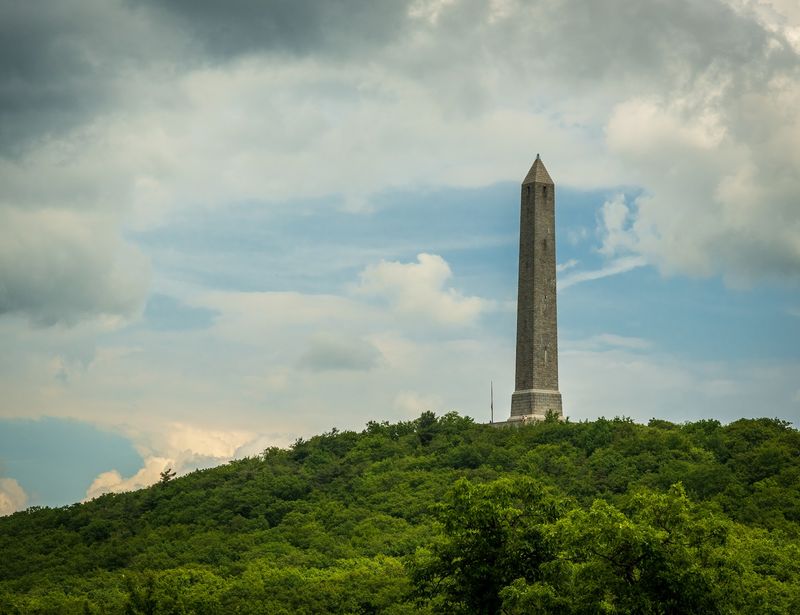
Colonel Anthony Kuser and Susie Dryden Kuser owned this mountaintop once. In 1923, they donated their 10,000-acre estate to the people of New Jersey.
Their goal was simple and generous. They wanted everyone to enjoy the scenery and recreation at the state’s highest elevation.
Four years later, in 1927, the couple offered something more. They agreed to fund a monument honoring every New Jersey citizen who served in any war.
Construction began in the summer of 1928. Crews finished by early summer 1930, using local materials whenever possible.
Some of that stone was quartzite quarried right inside the park. The mountain quite literally helped build its own landmark.
Sadly, Colonel Kuser passed away in February 1929. He never saw the finished tower, which was dedicated on June 21, 1930.
Still, his vision stands tall nearly a century later. Generations of families have climbed the ridge because of that gift.
In 2019, the park received its longer official name. Adding New Jersey Veterans’ Memorial made its purpose clearer than ever.
It’s a lovely reminder that great places sometimes begin with plain old kindness. Not a bad legacy for one couple.
Granite, Quartzite, And A Nod To Bunker Hill
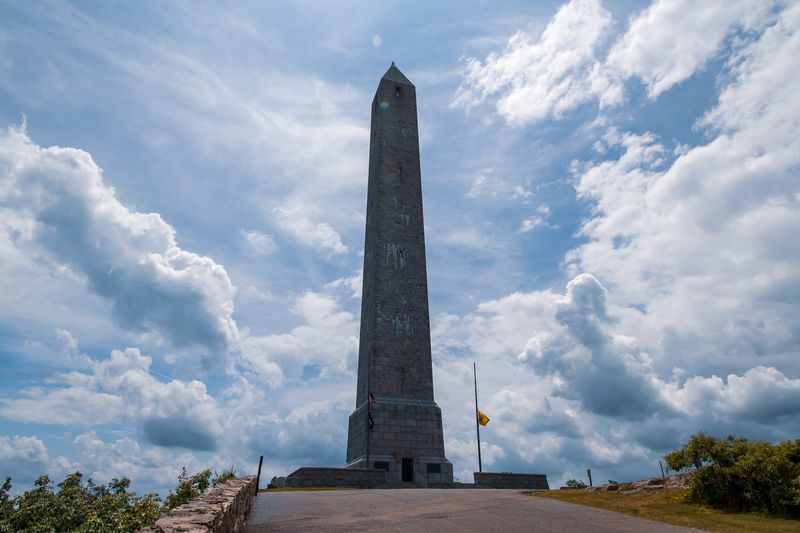
Boston fans might feel a flash of deja vu here. The High Point Monument was modeled after the Bunker Hill Monument in Massachusetts.
The resemblance makes sense once you see that clean, tapering shape. It’s classic obelisk style, built to look dignified from miles away.
At its base, the structure measures 34 feet square. From there it narrows gracefully as it climbs 220 feet into the sky.
The exterior is clad in granite. Local quartzite from within the park went into the work too.
Near the doors, look for a bronze tablet. Its words dedicate the tower to New Jersey’s heroes by land, sea, and air, in all wars of our Country.
Reading that inscription before climbing changes the mood a little. Suddenly every step feels like a small tribute.
The grounds around the base are open during regular park hours. So even when the inside stays locked, you can still admire the stonework up close.
Spend a minute circling the whole thing. Different sides catch light differently through the day.
Photographers, take note. A wide shot from below makes that granite spire look endless.
Your Legs Will Remember All 291 Steps
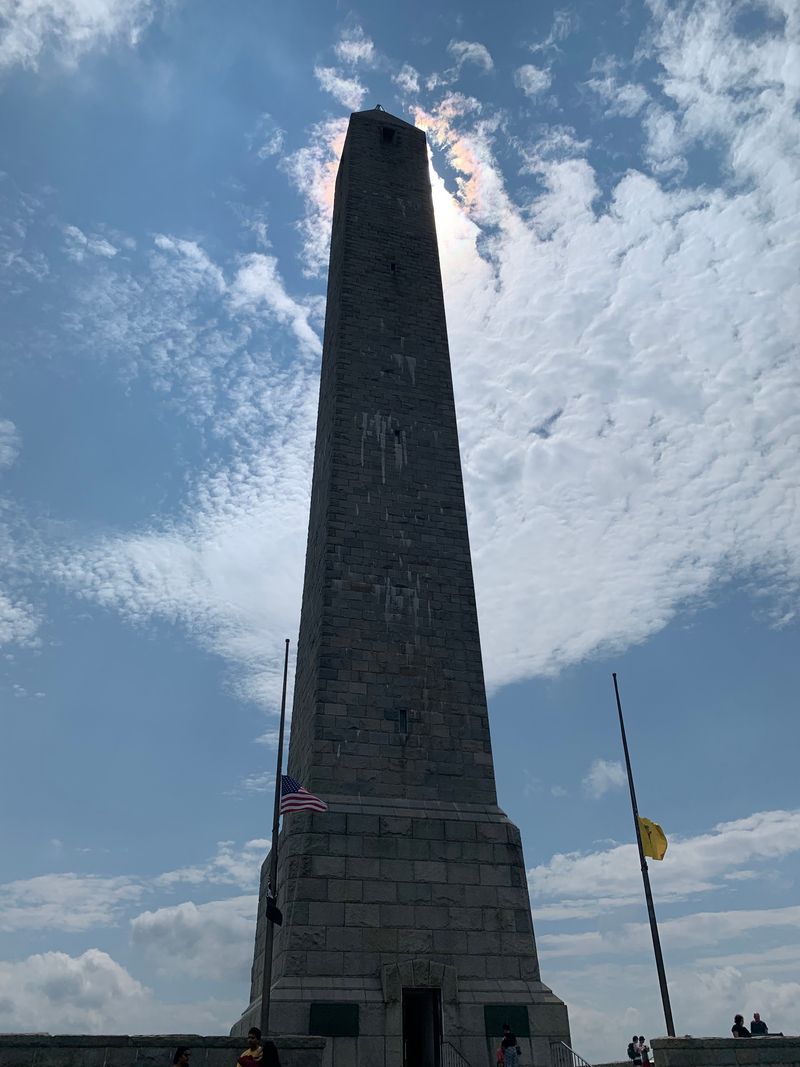
Count them if you like, but your calves will keep score anyway. The climb inside the monument covers 291 steps to the observation platform.
The journey starts in an octagonal chamber at ground level. From there, a narrow circular staircase spirals upward through the tower.
It’s snug in there, so take your time. Passing other climbers may call for a little polite shuffling.
The air can feel warm and muggy near the top, especially in summer. A water bottle is a smart sidekick.
Is it hard? It’s manageable for many people at a steady pace.
Still, anyone with knee trouble or a fear of tight spaces should think it over.
Only the base area and the first floor are handicap accessible. Everyone can still enjoy the sweeping views from the summit grounds outside.
Kids often treat the stairs like a race. Parents may prefer the slow-and-steady approach with breaks.
There’s a small fee to go up, which may change from year to year. It’s pocket change compared with the payoff.
And that payoff is coming. Every turn of the spiral brings the windows closer.
New York, Pennsylvania, And Home All In One Glance
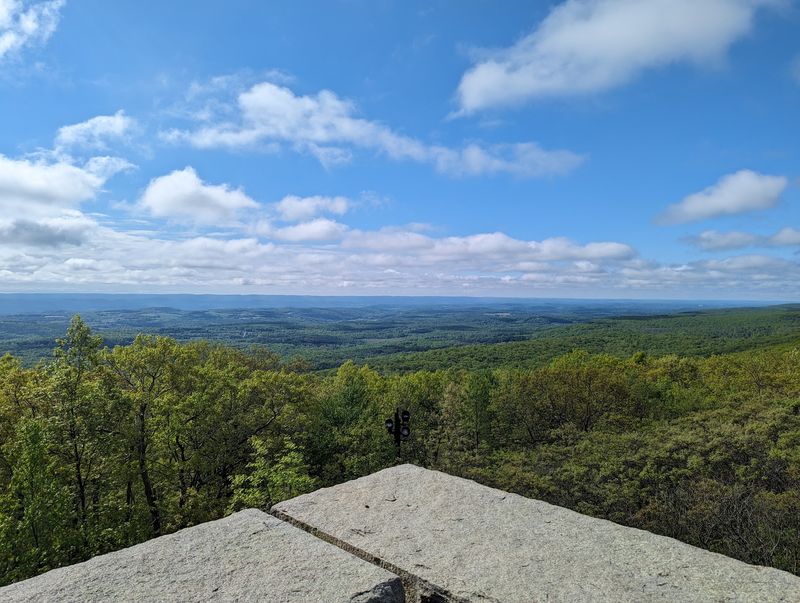
Here’s the moment the whole climb was building toward. From the top, three states spread out in one sweeping panorama.
Look west for Pennsylvania and the ridges of the Pocono Mountains. Turn north, and New York’s Catskill Mountains line the horizon.
Southeast, the Wallkill River Valley rolls away in farm fields and forest. That’s New Jersey, looking pretty proud of itself.
On a clear day, the Delaware River shows up too. It traces the border between New Jersey and Pennsylvania like a silver ribbon.
Fall is a showstopper season up here. Late September through mid-October can paint the ridges red, orange, and gold.
Sunsets from the summit area also earn plenty of love. The glow over Pennsylvania can make anyone pause.
Haze may soften the far horizon on muggy days. Crisp, clear mornings usually offer the sharpest lines.
Don’t skip the view from the base, either. Even without the climb, the summit lawn offers wide vistas in every direction.
Bring a jacket no matter the forecast. That ridge-top wind cuts right through a thin sweatshirt.
Fifty Miles Of Trails, Including A Famous One
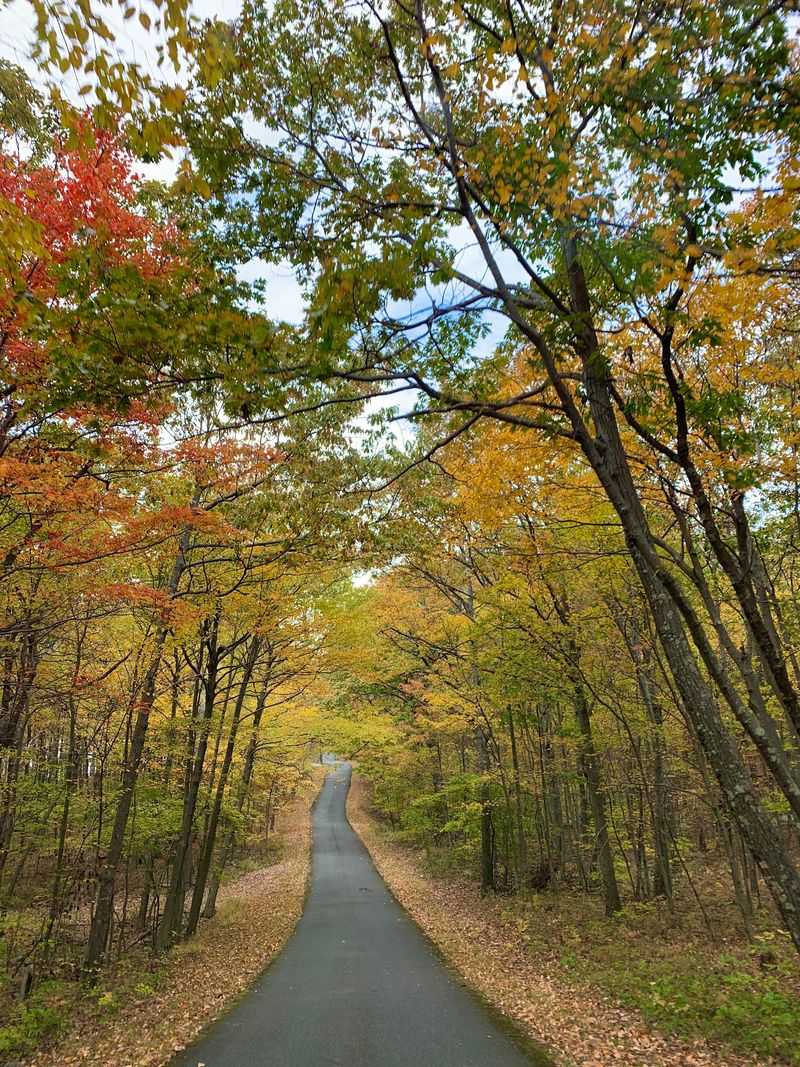
Hikers, you’re in for a treat. High Point State Park holds more than 50 miles of trails, from half a mile to 4.4 miles long.
About 18 miles of the Appalachian Trail follow the Kittatinny Ridge right through the park. That’s the same footpath stretching from Georgia to Maine.
Thru-hikers can rest at three designated shelters here. They’re named Mashipacong, Rutherford, and High Point.
Want to earn the monument the old-fashioned way? The Monument Trail climbs up from below, while a short path from the lot runs about 0.2 miles each way.
Nature lovers should seek out the Cedar Swamp Trail. This easy 2.5-mile loop circles an Atlantic white cedar bog in the Dryden Kuser Natural Area.
A bog like that is considered rare at such a high elevation. It’s quiet, shady, and wonderfully different from the windy summit.
Many trails also welcome mountain bikes and horses. The Appalachian Trail, though, stays foot traffic only.
Some paths get rocky, so sturdy boots help. Leashed dogs are welcome on trails too.
Your step counter will be thrilled.
A Spring-Fed Lake Just Below The Summit
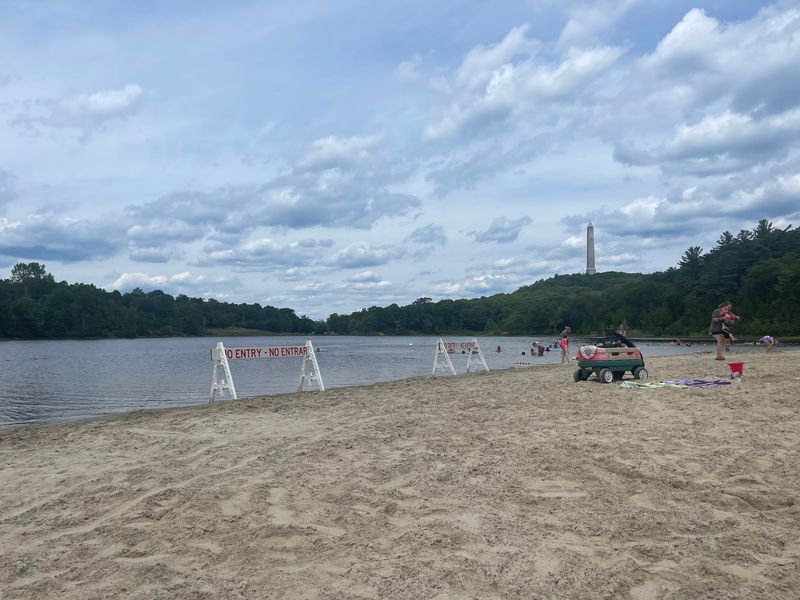
Swimming on a mountaintop sounds a little made up. Lake Marcia proves it’s real.
This spring-fed lake sits at 1,570 feet, just below the monument. Swimming is allowed from Memorial Day weekend through Labor Day weekend, with lifeguards on duty.
The beach complex includes a bathhouse and concessions. That means no awkward towel changes behind the car.
Nearby, Sawmill Lake has a different personality. It offers fishing and boating with electric motors only.
The Civilian Conservation Corps created Sawmill Lake in the 1930s. Crews shaped it from what used to be an Atlantic white cedar swamp.
Picnic tables and shelters dot the park. Charcoal grills and several playgrounds make it easy to turn a hike into a cookout.
Families can easily spend a whole summer afternoon here. Swim, eat, climb the tower, then swim again.
One friendly tip for the evening crowd. Clean up every crumb, since black bears do live in this part of New Jersey.
Swim season is short and sweet. Plan your beach day while the lifeguards are still in their chairs.
Fall Asleep Near The Top Of New Jersey
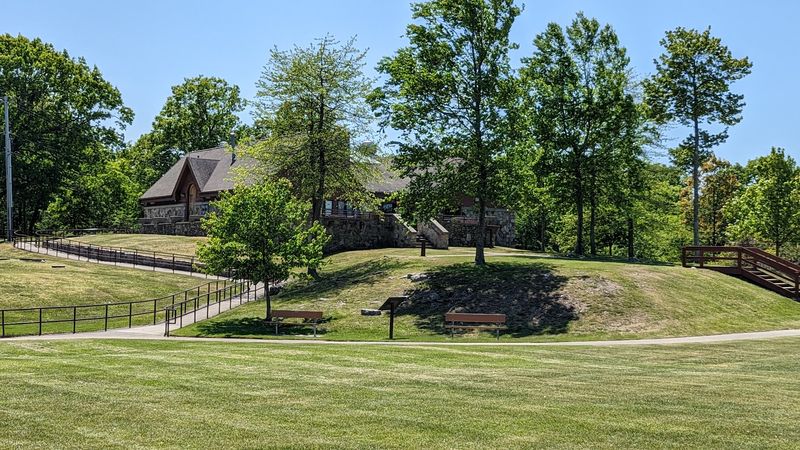
Why rush home when the stars are this good? High Point State Park offers 50 tent sites along Sawmill Lake.
Each site comes with a fire ring and a picnic table. Waking up beside a mountain lake is a pretty great alarm clock.
Bigger crews have options too. Two group campsites hold 25 and 35 people.
Prefer walls and a roof? Two furnished cabins each sleep six, and a group cabin fits up to 28.
The cabins open seasonally. Reservations are a smart move, especially during the busy summer months.
Appalachian Trail hikers follow different rules. Stays are limited to one night per shelter, and fires aren’t allowed there.
Camping here lets you catch the summit at quieter hours. Early mornings on the ridge can feel peaceful and fresh.
Store food carefully overnight. Wildlife has a great nose for unattended snacks.
Even one night can make the trip feel like a real getaway. And you never left the state.
Snowshoes, Skis, And A Very Chilly Summit
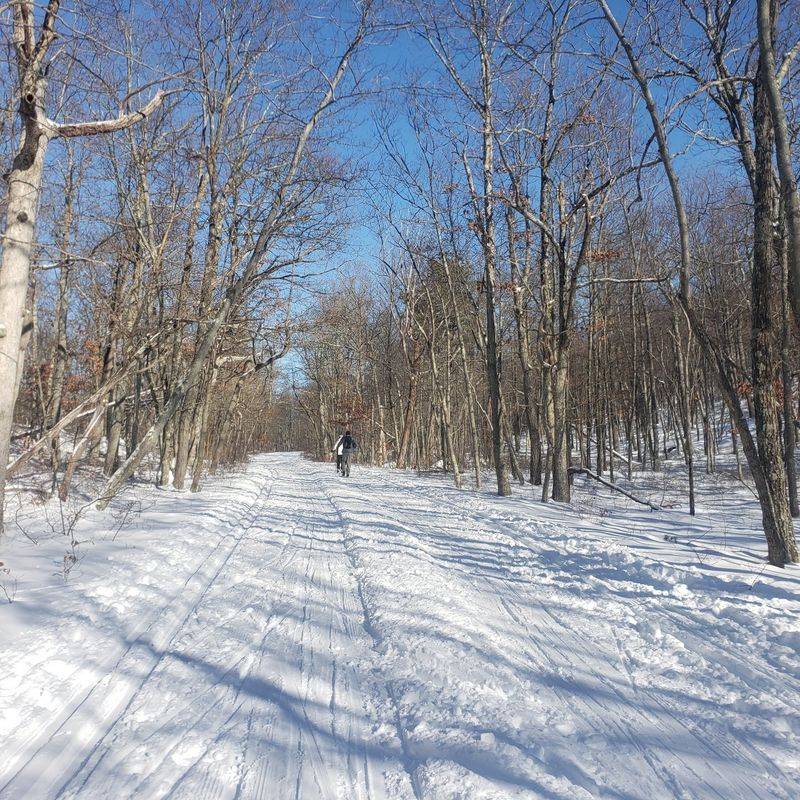
Snow transforms this ridge into something else entirely. The High Point Cross-Country Ski Center grooms 15 kilometers of trails when natural snow arrives.
Skis and snowshoes are available to rent from the lodge. It sits right next to the park’s Interpretive Center.
A trail pass is required for certain areas while the ski center operates. Check conditions before loading up the car.
The fun keeps going beyond skiing. Ice skating, ice fishing, and snowmobiling happen in designated areas.
Some park roads close to cars in winter, including Ridge Road and Sawmill Road. You’re still welcome to explore them on foot.
The monument interior stays closed during the cold months. Access to the summit area may also depend on icy road conditions.
Still, a frosty view from the base can feel magical. Bare trees open up even wider sightlines across the valleys.
Dress warmer than you think you need. That mountaintop wind doesn’t take winters off.
Hot cocoa in a thermos? Strongly encouraged.
Plan Smart And Then Go Climb That Tower
Getting here is half the fun. The park office sits at 1480 NJ-23, Sussex, NJ 07461, with Route 23 skirting the park.
Gates open daily at 8 a.m. From April through November they close at sunset, and in winter they close at 4:30 p.m.
The monument interior typically opens weekends from Memorial Day weekend through Columbus Day. Hours run 8:30 a.m. to 3:45 p.m., depending on weather and staffing.
Vehicle entrance fees apply from Memorial Day weekend through Labor Day. Hikers using the Appalachian Trail lot on Route 23 can park without a fee.
Weekend lots may fill by early afternoon, especially in fall. Arriving early makes parking much easier.
Parking right at the monument can be limited. Lower lots and a hike up are great backups.
Leashed dogs are welcome, but not in buildings or swimming areas. Restrooms and picnic tables sit near the main lots.
So is it worth the drive? For a family day packed with history, views, and fresh air, I’d say absolutely.
Bring a jacket and some patience. New Jersey’s rooftop is waiting.